Robert Hall exhibits daguerreotype portraits of Aboriginal people in the Exhibition of Pictures, the Works of Colonial Artists at the Legislative Council Chambers, Adelaide, organised by Samuel Thomas Gill. These are the earliest known daguerreotypes of Aboriginal subjects, but not extant.
J. W. Newland sets up a Daguerreian Gallery on the corner of King and George Streets, Sydney in March. The almost two hundred daguerreotypes included views acquired whilst Newland had travelled through Jamaica, Haiti, Panama, Honduras, Peru, Chile, Tahiti, Fiji and New Zealand in 1846–47. They included portraits of Queen Pomare and the royal family from Tahiti, Fijians, Maoris, chiefs from other Pacific Islands, and portraits and views from Peru, Chile and Grenada, including panoramas of Peruvian cities. The Sydney Morning Herald recommended that:
The Australian public should pay a visit to this gallery … The enterprising artists … present us not only with characteristic portraits of its native inhabitants, but landscapes of considerable beauty.
Sydney Chronicle reported that:
Besides, however, the foreign scenery and foreign faces, there are some scenes, and a good many portraits, which the Sydney visitor will recognize instantly. Indeed, the extreme accuracy of the portraits, even to the most minute lines, is surprising.
In October Newland exhibited the Daguerreian Gallery in Hobart.
Exhibitions are held in Sydney, Hobart and Melbourne of works to be sent to the Paris Universal Exhibition in 1855. Australia had sent agricultural products to the Great Exhibition of 1851 in London, but Paris provided one of the earliest opportunities to show the progress of Australian colonies in an international context. Gael Newton notes that the Australian commissioners complained of local indifference to the exhibition.
Thomas Glaister—from the New York studio of Meade Brothers & Co—sets up the American Australian Portrait Gallery in Sydney in April 1855, importing the technical sophistication, size and style of American photography to his Australian daguerreotypes and collodion processes
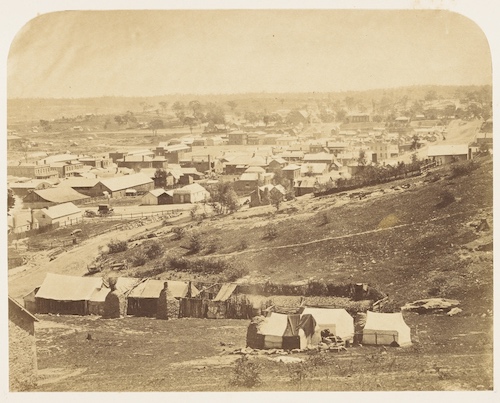
John Smith, William Stanley Jevons, Robert Hunt and Mathew Fortescue Moresby exhibit their photographs at special “conversazione” evenings held in Sydney in December 1858 and December 1859 by the Philosophical Society, to which they belonged. Although preceded slightly by a demonstration by George Pownall, Anglican Dean of Perth, at the Perth Mechanics Institute in September 1858, these are, according to Gael Newton, “the earliest purely photographic exhibitions”.
Richard Daintree and Antoine Fauchery produce Sun Pictures of Victoria, the first photographic collection depicting Melbourne and the colony of Victoria, portraying the goldfields, Melbourne Streets, landscapes and portraits of Indigenous Victorians.
Redmond Barry, the President of the Melbourne Intercolonial Exhibition, commissions the German photographer Charles Walter to make a series of portraits of the residents of Coranderrk Aboriginal Station (1863–1924). The portraits are incorporated into one large display panel and subsequently sent to Russia, Italy, and England as “evidence” in scientific debates about human evolution. Landscape photographs in the Intercolonial Exhibition (such as Charles Nettleton’s panoramic views of Melbourne) are reviewed in the Australia Monthly Magazine under the title “A Wanderer Among the Photographic Views at the Intercolonial Exhibition”.
Richard Daintree’s photographs are exhibited as part of the Queensland display, built as a separate annex off the main pavilion, at the London Exhibition of Art and Industry. This exhibition was held annually between 1871 to 1874. A second copy of these hand-coloured photographs were simultaneously on display at the Vienna Exhibition in May 1873.
Twenty Julia Margaret Cameron photographs are displayed in the Drawing Room of Government House, Sydney, New South Wales, by Cameron’s friend Governor Hercules Robinson.
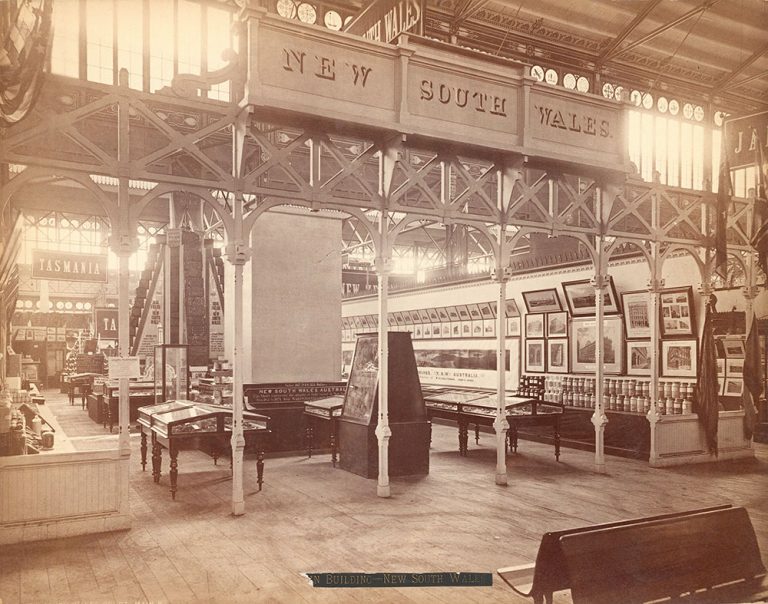
Charles Bayliss’ panorama of Sydney is exhibited as part of the New South Wales exhibit at the Philadelphia Centennial International Exhibition, directed by the gold miner, businessman, and politician Bernhardt Holtermann. Known as the Holtermann panorama, it receives a bronze medal.
The Philadelphia Centennial International Exhibition included extensive displays of photography from the colonies of Australia. Daintree’s 200 strong hand-coloured photographs of rural and mining regions lined the 15 ft high and 100 ft long walls of the Queensland pavilion. Joseph Turner’s photograph of the moon taken through the Great Melbourne Telescope can be seen in the Victorian pavilion. It would go on to be displayed at the 1886 Colonial and Indian Exhibition in London and the 1887 Dublin Exhibition.
Charles Bayliss’ panorama of Sydney is exhibited at Paris Exposition Universelle Internationale.
J.W. Lindt and Charles Nettleton exhibit portraits and landscapes as part of the Victorian exhibition at the Melbourne International Exhibition. Lindt complains in the press about his works’ display being separate to the Victorian works of sculpture and painting. His images are shown near the entrance to the cellars, behind the organ, off the main building (Argus 27 September 1880, 6).
Thomas Baker, one of the first to manufacture dry plates locally, teams with amateur photographer J.F.C. Farquhar to open their rooms in Elizabeth Street, Melbourne as the “Victorian Gallery of Australian Views” with an exhibition of “argentic bromide” enlarged landscape photographs (with some prints over a metre square). The Sun newspaper of 28 February declares:
“The bromide produces real works of art, giving a soft finish to the pictures, equal to the finest engravings. The object of the firm is to supply pictures of national life for home decorations, at a modest price.”
The exhibition review is headed “Exhibition of Artistic Photographs,” suggesting a new emphasis on artistry in the assessment of photographs in the 1890s.
The Northern Tasmanian Camera Club holds its first intercolonial show, followed by the Geelong Amateur Photographic Society in 1895, which also serves as a congress – one of the few occasions when photographers travelled from interstate to get together.
Members of the South Australian Photographic Society are represented in the South Australian Chamber of Manufacturers Exhibition of Art and Industry. This show is significant for its mixed hanging of photographs and traditional works of art, and it included prints and stereographs by H.H. Tilbrook (1848–1937), founder of the Northern Argus newspaper in South Australia.
Benjamin Cowderoy exhibits a group of talbotypes in a photographic exhibition at the Melbourne Museum and Aquarium, near the current Royal Exhibition Building, Carlton. (The photographic exhibition also included photographs of New Guinea by J W Lindt, and a ‘poetic’ image by John Kauffman.) Cowderoy, who was president of the Melbourne Chamber of Commerce, had been manager of William Henry Fox Talbot’s Reading printing establishment in 1846, when he had assisted with the production of The Pencil of Nature and the promotion Talbot’s process. At the Melbourne exhibition Cowderoy lectured on the talbotypes and his relationship with Talbot, to celebrate the ‘jubilee’ of photography. The Melbourne Argus commented:
The specimens which are considered of most interest are those which represent portions of Laycock Abbey and the adjacent park, as they were the first objects which Mr. Talbot experimented upon with his camera. As these pictures are nearly 50 years old, and were produced when the chemistry of the process was less perfectly known than now, they have, for the most part, a very faded appearance as compared with the fresh and newly executed works of today. (Argus, 18 February 1895, p. 7)
Cowderoy had previously lectured on his relationship with Talbot at a Chamber of Commerce ‘At Home’ in 1893, at which Lindt had shown lantern slides of the New Hebrides, and Mr H L J Ellery had shown lantern slides of the sun, moon and stars taken through the Melbourne Observatory.
The 1901 exhibition of the South Australian Photographic Society at the institute rooms, North Terrace, is considered “one of the finest” by a reviewer in the South Australian Register/The Advertiser, because “some of the works … could easily be mistaken for etchings and paintings. All the sharp and hard lines which one is so accustomed to associate with photography are absent and the exhibits are perfect pictures and delightful works of art.”
A print by Edward Steichen is exhibited by the Photographic Society of New South Wales, which: “gave an opportunity to compare [his] work with the production of the local men”.