(Installation View, pp. 383–396)
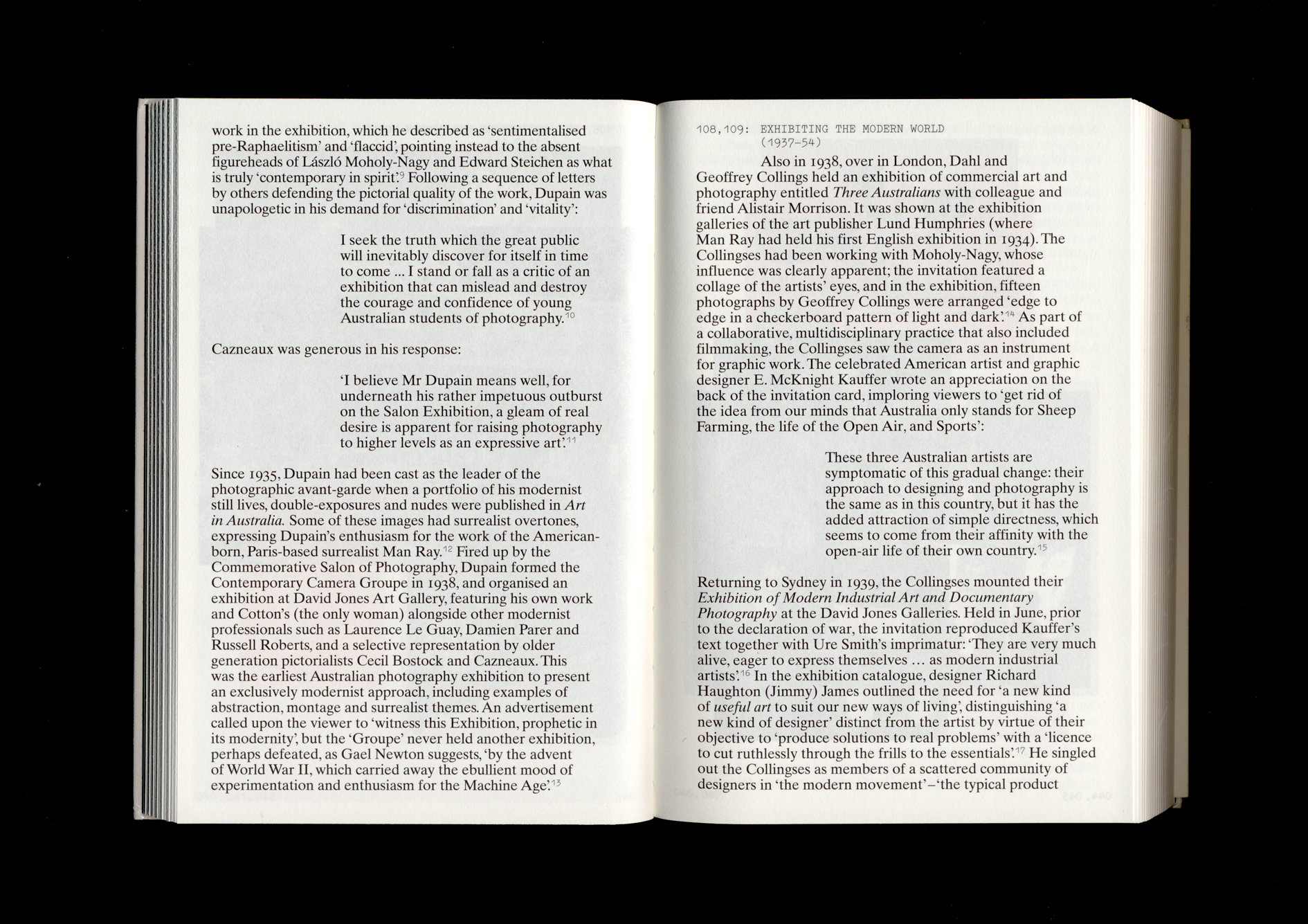
Since the 1970s, exhibitions of Australian art photography have regularly toured overseas. Asia has often been the primary destination, due to geographical proximity, but this tendency also echoes Australia’s economic and political ambitions in the region. Australian photographers have also always been international photographers. In the nineteenth century Australian, colonial photographers such as J. W. Lindt or Richard Daintree built their Australian careers on their acceptance into British, European and US exhibitions. In the first half of the twentieth century, Australian pictorialist photographers regularly exhibited in international salons, especially in Britain, but also in Europe, America and Asia – particularly Japan – just as international photographers exhibited in Australian salons (for example, Japanese photographer Kiichiro Ishida, who lived in Australia from 1919–23, was invited to become a member of the exclusive Sydney Camera Circle in 1921). However, the notion of the international touring show is essentially a contemporary phenomenon, enabled both by the rise of art photography itself and its supporting institutions, as well as by the increasingly interconnected world of globalisation since the 1970s.1 Although the focus in the touring show is squarely on photography as an artform rather than a communication medium, the inevitably ambassadorial role of these exhibitions can be read as updating and revising the more overtly instrumental and promotional role that photography played in world fairs, exhibitions and expos in previous decades.
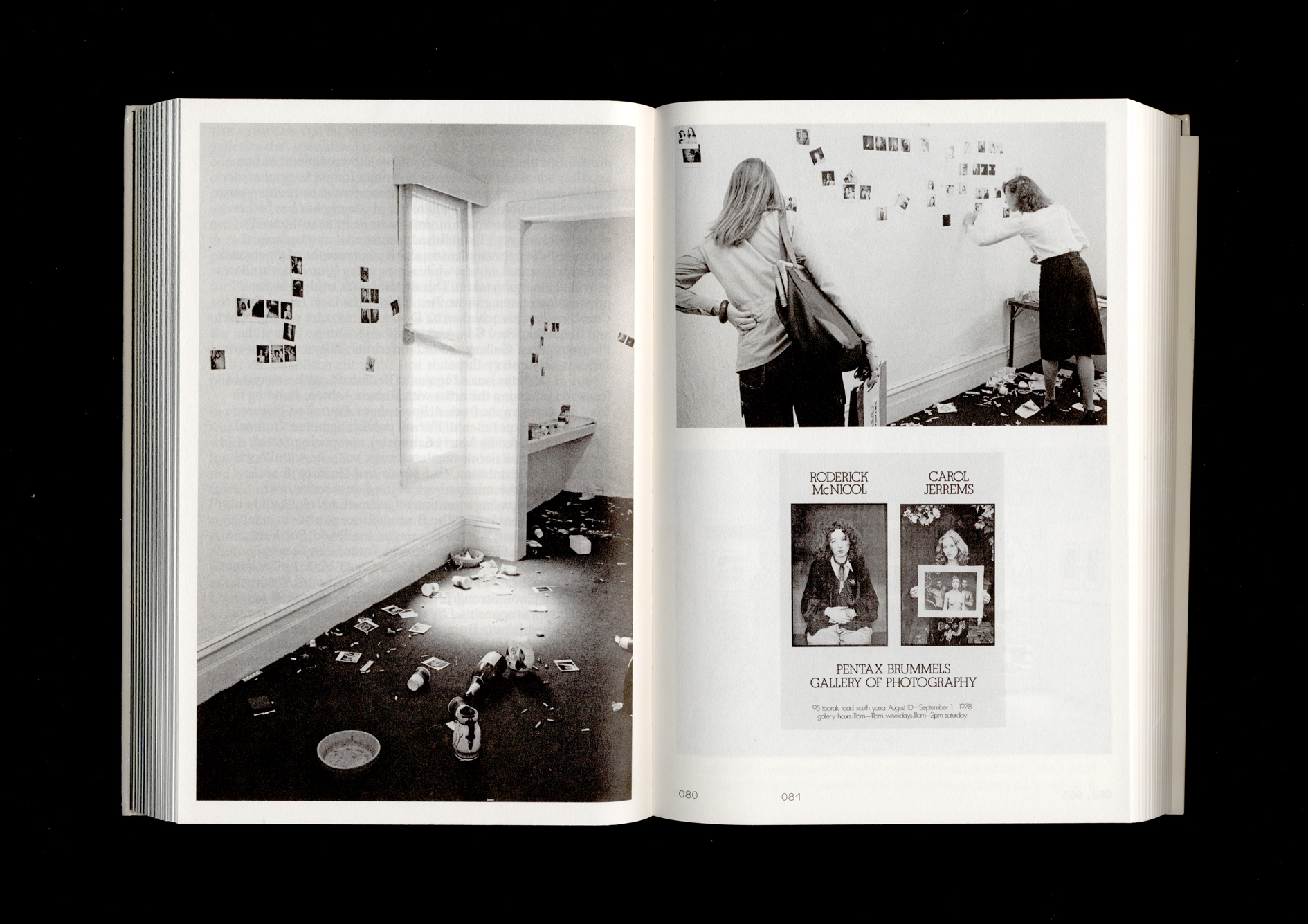
Since its founding in 1974, the Australian Centre for Photography (ACP) has played an important role in developing international exhibitions as part of its charter to promote Australian photographers. Under inaugural director Graham Howe, Recent Australian Photography – which included four of the six photographers in the ACP’s opening show, together with ten others – toured to Australian embassies and high commissions in Malaysia, the Philippines, Indonesia, Singapore, Thailand, Japan, Burma, India, Sri Lanka and South Africa in 1975 and 1976, supported by the Department of Foreign Affairs. Notably, Max Pam was excluded from the line-up, presumably because his louche photographs of the hippy trail in Southeast Asia might have been misinterpreted. The exhibition featured work by fourteen photographers – Godwin Bradbeer, Warren Breninger, John Cato, Ian Dodd, Max Dupain, Rennie Ellis, Richard Harris, David Moore, Grant Mudford, Jon Rhodes, Roger Scott, Wesley Stacey, John Walsh and Richard Woldendorp. Dupain, Moore and Woldendorp represented the older generation. Extraordinarily, no women were included. As Deborah Ely, a later director of ACP has observed, ‘It is a characteristic of the early years of the ACP that its governing culture was exceptionally male … “debate” between the founding fathers of ACP and feminists grew up over the years and persisted into the 1980s’.2 And of course, there were no Indigenous artists in the exhibition nor anyone from a non-European background. The fourteen artists included presented their individual interpretations of Australia in the form of 106 colour and black-and-white photographs of landscapes, buildings and people. Most of the work was fine print black-and-white ‘new documentary’ in the then privileged tradition of John Szarkowski; Ellis’ and Rhodes’ works were more photojournalistic; and Bradbeer’s and Breninger’s more personal. Perhaps the most ‘contemporary’ inclusion was Wesley Stacey’s small colour snapshots taken from his car window, The Road, 1974–75, which had recently been presented at the ACP. While we can only imagine the reaction of diverse viewers to the work – in the context of Southeast Asia just emerging from the Vietnam War – archival pictures from the Bangkok leg show an engaged public, including students, viewing the photographs presented on concertina-style partitions. In the brochure, founding ACP committee member Craig McGregor wrote that ‘a younger generation of photographers has arrived, which is not concerned simply to record reality; many of them wish to remake it. They wish to distort it, make comments about it, use it for their own purposes – in other words, to regard reality as merely the raw material for something else’.3
No touring exhibitions of a similar scale were attempted by the ACP for more than twenty-five years. Alasdair Foster, a Scot who had moved to Sydney in 1998 to become director of the national photography centre, on a mission to expand its audience, had become fascinated by the unfashionable theme of Australia’s national identity and developed an exhibition for the Spanish art fair ARCO 2002 in Madrid, Photographica Australis. The cover of that catalogue featured Anne Zahalka’s hyperreal image of Bondi surf lifesavers. Photographica Australis then toured through Asia (with a new catalogue featuring Michael Riley’s superimposed bird feather on a cloud background) to the Singapore Art Museum and the National Gallery of Thailand in Bangkok in 2003, and then represented Australia in the 11th Asian Art Biennale in Dhaka, Bangladesh, in 2004, before concluding at the Taipei Fine Arts Museum. According to a review in Taipei Times, the exhibition ‘aims to help Asian viewers take note of the diversity of Austrian [sic] culture’.4 Indeed, in contrast with Recent Australian Photography, Photographica Australis presented both a more inclusive and phantasmic vision, reflecting many of the changes to Australian society and art in the quarter-century between the two exhibitions. Nearly half of the artists were women, and two were Indigenous (Croft and Riley, both presenting more or less melancholic montage work). But nothing really connected the work, which ranged from the postmodern to the surreal, the bleak to the poetic. Its three sections, ‘Bio-diversity’, ‘Art and Suburbia’ and ‘Intersection’ (around identity), attempted to corral the actual concerns of the seventeen artists – Pat Brassington, Lyndell Brown and Charles Green, Brenda L. Croft, Max Doyle, Rose Farrell and George Parkin, Joachim Froese, Philip George, Deborah Paauwe, Polixeni Papapetrou, Scott Redford, Michael Riley, Glenn Sloggett, Darren Sylvester, Martin Walch, and Anne Zahalka. Formally, most of the works were conventional –prints either pinned to the wall, framed or mounted on aluminium – although Walch’s installation invited the audience to view landscapes of a Tasmanian mining site through stereo viewers. Only Sloggett’s work could be called documentary. All except Froese’s close-up images of insects were in colour. Australia’s most famous artists working with photography, Bill Henson and Tracey Moffatt, were notably absent.
Since the 1960s, exhibitions of Australian art in the UK had significantly declined in the context of a newly emergent cultural nationalism. In 1982, however – the same year that Bernice Murphy presented photography as contemporary art in the first Perspecta – the major exhibition Eureka! Artists from Australia showed across both the Serpentine Gallery and the Institute of Contemporary Art (ICA) in London. Curated by Sue Grayson and Sandy Nairne in the UK with Nancy Underhill from the University of Queensland, the exhibition was the first major Australian art show in London since 1963. The photographers at the Serpentine were Micky Allan and Wesley Stacey (who showed alongside painters Peter Booth and Imants Tillers). The ICA show featured Virginia Coventry, Peter Kennedy, John Lethbridge alongside performance artists Jill Orr and Mike Parr. A few years later in 1988, assisted by the Australian Bicentennial Authority, ICA curator James Lingwood presented Elsewhere: Photo-Based Work from Australia, featuring the postmodernists Julie Brown-Rrap, Jeff Gibson, Bill Henson and Jacky Redgate. The title was ironic but spoke to ‘a state of dislocation and displacement which is the symptom of any media-saturated society’ and ‘a still colonial, Eurocentric aspiration of what Australia should be’.5 None of the four artists were Indigenous – the proliferation of Aboriginal artists working with photography was still to come – but catalogue essayist Ross Gibson referred to non-Aboriginal Australians and the gradual maturation of Australia as a colonial society as it fabricates a sense of place against the fiction of the ‘classically Australian’.6 Such exhibitions of Australian photography initiated by international institutions have been rare, reserved only for the most successful, such as Bill Henson (who showed at the Photographers’ Gallery in London in 1981 and frequently in Europe and the US from the late 1980s), Tracey Moffatt (including a major exhibition, Free-Falling at the Dia Center for the Arts in New York in 1997) and Rosemary Laing. More commonly, the exhibition of Australian photography overseas has involved exporting or exchanges, particularly with major trading partners.
Gael Newton’s 1979 historical exhibition Australian Pictorial Photography toured to three cities in China, including Beijing, when Edmund Capon as director of the Art Gallery of New South Wales sought an exchange for a major exhibition of Chinese painting.7 During the 1980s, the Department of Foreign Affairs and Trade encouraged links between contemporary art in Australia and Asia. One outcome was Continuum 83: The 1st Exhibition of Australian Contemporary Art in Japan, which ran across fifteen venues in Tokyo. With an Australian organising committee that included Ken Scarlett, Judy Annear and John Williams among others, the exhibition featured Sue Ford’s Time Series, Virginia Coventry’s Whyalla – Not a Document, John Williams’ Living Room Portraits and Douglas Holleley’s A Portfolio of Colour Photographs Made on the Last Day of Luna Park. It also featured documentation of women’s performance art curated by Anne Marsh and Jane Kent. Thirty Australians visited for the opening – Stelarc, Lyndal Jones and Mike Parr all performed – and the Australian ambassador to Japan held a reception at the embassy. Japanese investment in Australia was booming in the 1980s, along with Japanese tourism. In 1987, under the title Pure Invention, the ACP toured Fiona Hall, Jacky Redgate, Robyn Stacey and Anne Zahalka to PARCO Space 5 in Tokyo. Besides all being women, according to the catalogue, the four photographers all worked ‘against naturalism, photography’s privileged hold on the “real” and the tenet of the photodocumentary and straight photographic practices which have long seemed dominant’.8 The following decade, Victoria Lynn’s Strangers in Paradise: Contemporary Australian Art to Korea, 1992, included Rosemary Laing, Lindy Lee, Julie Brown-Rrap and Robyn Stacey. Extraordinarily, the Australia Council increased arts funding to projects connecting with the Asia-Pacific from 12.5 per cent to fifty per cent between 1991 and 1993.9 With the support of new agencies such as Asialink (1991–), exhibitions became more common from the late 1990s. Natalie King curated a series of photography exhibitions for Asian venues, commencing with Rosemary Laing: Aero-Zone in 1999 at the National Museum of Art, Osaka (in exchange with Monash University Gallery and ACCA). In 2004, with Gertrude Contemporary Art Spaces, King curated Supernatural Artificial for the Tokyo Metropolitan Museum of Photography, described in the press release as ‘a highly charged and moody exhibition, which uncovers the unnatural and theatrical in contemporary photographic practice’. It featured nine Australian artists working in photography and video including Pat Brassington, Moffatt, Darren Sylvester and Zahalka, and after Tokyo toured to Bangkok, Hanoi, Singapore and the 2006 Asian Art Biennale Bangladesh in Dhaka. That exhibition paved the way for King to tour a retrospective of Indigenous artist Destiny Deacon: Walk & Don’t Look Blak to the Tokyo Metropolitan Museum of Photography in 2006, after first being shown at the Museum of Contemporary Art in Sydney and Tjibaou Cultural Centre in Noumea, New Caledonia. Earlier, in 2001, Michael Snelling from Brisbane’s Institute of Modern Art curated Tracey Moffatt to coincide with that year’s Asia Pacific Triennial, which then that toured to Taipei Fine Arts Museum and Art Sonje Center in Seoul later that same year. In 2010, Alasdair Foster developed another ACP touring exhibition, Imagining the Everyday, for the Pingyao International Photography Festival in China. Presented as part of the Australian Government’s ‘Year of Australian Culture in China’, work by twenty Australian photographers drawn from every state and territory were arranged according to Chinese numerology.10
Despite the prevalence of Australian exhibition exports to Asia, Australian state galleries continued to import contemporary photography exhibitions primarily from the US and Europe. For instance, the National Gallery of Victoria’s roster since the 1990s has included Adam Fuss (1992), Doug and Mike Starn (1993), Annie Leibovitz (1996), Andres Serrano (1997), which was controversially closed after just a few days after one of the works was vandalised, Andreas Gursky (2008), Jeff Wall (2012), Thomas Demand (2012) and William Eggleston (2017). Curators have increasingly adopted a deliberately international approach. For example, Judy Annear, curator of photography at the Art Gallery of New South Wales (AGNSW) from 1995 to 2016, took on the canonical international behemoths August Sander in 2007, Alfred Stieglitz in 2010 and Eugène Atget in 2012.
Exports of Australian photography back to Europe and America have been much less common. Nevertheless, in 2000, Bernice Murphy (former curator of contemporary art at the AGNSW and director of the Museum of Contemporary Art) presented her pick of the most significant Australian artists working with photography for the prestigious Neuer Berliner Kunstverein (NBK) in Germany, and touring to Dresden, Düsseldorf and Stuttgart. Titled Contemporary Photographic Art from Australia (Zeitgenössische Fotokunst aus Australien), it featured six women and four men, and focused on conceptual and performance art-based approaches to the medium, reflecting Murphy’s investment in the 1980s generation including Bill Henson, Anne Ferran and Moffatt, as well as Mike Parr and Peter Kennedy.
In 2019, the Museum of Photographic Arts in San Diego presented more than one hundred photographic works by thirteen artists in Defining Place/Space: Contemporary Photography from Australia, which director Deborah Klochko selected on the basis of nominations from five Australian curators.11 The artists featured in the exhibition were Hoda Afshar, Polly Borland, Pat Brassington, Michael Cook, Rosemary Laing, Ricky Maynard, Tracey Moffatt, Polixeni Papapetrou, Trent Parke, Patrick Pound, Jacky Redgate, James Tylor and Justine Varga – four Indigenous artists, eight women and only five men. According to the press release, ‘The exhibition shows that art-making in Australia is not just about the flora and fauna of the country’. Indeed, ‘Defining Place/Space is more than what people will expect. It shows a country at the forefront of photographic image-making’.12
-
On Japanese-Australian exchanges see: Melissa Miles and Robin Gerster, Pacific Exchanges: Photography and the Japan-Australia Relationship, ANU Press, Canberra, 2018. ↩
-
Deborah Ely, ‘The Australian Centre for Photography’, History of Photography, vol. 23, no. 2, 1999, p. 119. ↩
-
Quoted in: Belinda Hungerford, ‘Recent Australian Photography (1975–76 International Tour)’, Australian Centre for Photography Blog, Online at: https://acp.org.au/blogs/news/recent-australian-photography-1975-76-international-tour. Accessed on: 5 July 2019. ↩
-
Vico Lee, ‘Australian art explores its fundament’, Taipei Times, 22 February 2004, Online at: http://www.taipeitimes.com/News/feat/archives/2004/02/22/2003099767. Accessed 5 July 2019. ↩
-
James Lingwood, Preface, Elsewhere: Photo-Based Work from Australia, exhibition catalogue, Institute of Contemporary Art, London, 1988. ↩
-
Ross Gibson, ‘Elsewhere, Today: 2 False Starts about 4 Australian Artists’ in Elsewhere: Photo-Based Work from Australia, exhibition catalogue, Institute of Contemporary Art, London, 1988. ↩
-
Catherine De Lorenzo, ‘Shifting agendas?’, unpublished conference paper from the Art Association of Australia and New Zealand annual conference, University of Tasmania, 2014. ↩
-
Helen Ennis, ‘Introduction’, Pure Invention, exhibition catalogue, Australian Centre for Photography, Sydney, 1987. ↩
-
Joanna Mendelsohn, Catherine De Lorenzo, Alison Inglis, Catherine Speck, Australian Art Exhibitions: Opening Our Eyes, Thames & Hudson, Melbourne, 2018, p. 334: ‘Max Bourke, the Australia Council’s General Manager, made it clear this was an Australia Council decision, not a Foreign Affairs initiative, stating “we are in the business of cultural exchange”’. ↩
-
The photographers were Narelle Autio, Pat Brassington, Peta Clancy, Rebecca Dagnall, Marian Drew, Peter Fitzpatrick, Hayden Fowler, Murray Fredericks, Petrina Hicks, Garth Knight, Bronek Kozka, James Mellon, Denis Montalbetti & Gay Campbell, Deborah Paauwe, Polixeni Papapetrou, Scott Redford, Luke Roberts, David Stephenson, Lyndal Walker and Bronwyn Wright. ↩
-
The five Australian curators were Julie Robinson, Susan Van Wyk, Shaune Lakin, Gael Newton and Judy Annear. Alongside the contemporary work, the museum showed 35 examples of nineteenth- and twentieth-century Australian photography. ↩
-
‘Defining Place/Space: Contemporary Photography from Australia’, Museum of Photographic Arts, California, blog, 2019. Online at: https://mopa.org/exhibitions/defining-place-space. Accessed 5 July 2019. ↩