(Installation View, pp.273–284)
Ironically, the increasing use of photography by artists in the 1980s drew attention away from photography-specific galleries, increasingly viewed as ghettoised, or overly fixated on the fine black-and-white print (understood by many as a masculine fixation). As curator Isobel Crombie put it, as ‘attention shifted away from documentary work to the flashier, large-scale colour photographs most photography galleries, like … Church Street Photographic Centre in Melbourne, folded’.1 Nevertheless, while the Australian Centre for Photography (ACP) gathered strength from photography’s new centrality to contemporary art practice in the mid 1980s, photographers were restless. In Melbourne, for instance, feeling their needs were not met by the ostensibly national organisation, photographers pushed for a new centre. The result was the Victorian Centre for Photography (VCP), established as a resource centre in 1986 by founding coordinator Bernie O’Regan in response to a survey commissioned by the Victorian Ministry for the Arts into the needs of Melbourne photographers. The VCP operated without an exhibition space for several years, with its first public initiative being the 1988 exhibition The Thousand Mile Stare, curated by Joyce Agee, at the Australian Centre for Contemporary Art (ACCA), which had opened in 1984 on Dallas Brooks Drive, South Yarra.2 The exhibition surveyed a diverse range of Victorian photographic practice from the previous twenty-five years – including experimental, commercial and activist uses of the camera – intended as a catalyst for debate. Geoff Strong’s essay in the accompanying catalogue ‘The Melbourne Movement – Fashion and Faction in the Seventies’ outlined the clash of individuals, groups and institutions engaged in photography as a documentary or more self-consciously artistic medium. The exhibition was remarkably eclectic compared to the ACP scene in Sydney, or Helen Ennis’ collection survey at the National Gallery of Australia (NGA), Australian Photography: The 1980s, held in the same year to accompany Gael Newton’s historical survey Shades of Light.
The VCP eventually found a small gallery space of its own in 1990, in a terrace shopfront at 671 Rathdowne Street, North Carlton (with Deborah Ely as part-time founding director). Writing for The Age, Greg Neville noted that it aimed to provide a space and resource centre for ‘serious’ photography, but that ‘[T]he space unfortunately is very small’.3 The gallery opened in September 1990 with an ‘interactive’ exhibition by Jill Scott that used video and sound recordings to ‘evoke past and future technologies central to women’s lives’ – establishing an experimental and mixed-media tone that has largely endured. Other early exhibitions at the VCP included Self Documentation: Self Imaging – People Living with Aids in 1991 and Leah King-Smith’s series of large colour Cibachromes, Patterns of Connection, 1992, in which the Indigenous artist superimposed archival images of Indigenous people from the State Library of Victoria over her own photographs of the Victorian landscape (within months, images from that series toured the US, UK and Japan). With more certain funding from the state government, in June 1992 VCP moved to 205 Johnston Street, Fitzroy, and changed its name to Centre for Contemporary Photography (CCP) to reflect a contemporary rather than regional focus. As Susan Fereday (director from 1992–95) has observed: ‘several exhibitions at this time [early 1990s] contained no photographs at all, but artworks using other media to critique photography’s affects and psycho-social impact … Ultimately, CCP aimed to promote discourse around photography’.4 Indeed, during the late 1990s – under successive directors Stuart Koop, Charlotte Day and Tessa Dwyer – the medium of video was at least as prominent as photography at CCP, driven by trends among contemporary artists rather than photographers invested in photography’s tradition.5 In 2005, new director Naomi Cass negotiated a move to purpose-renovated premises at 404 George Street, Fitzroy. Despite financial precarity, CCP has maintained local support and membership through strategic exhibitions and programs catering to different constituencies, such as an annual open salon, a documentary photography award (1997–2011), weekend workshops and fundraising auctions.
The VCP/CCP story is echoed in smaller states and territories. A Western Australian centre for photography was set up in 1979 by Kevin Moore and John Ogden under the name of Quadrata on Stirling Highway, Cottesloe. This was one result of photographic courses being offered at the Perth Technical College and the Western Australian Institute of Technology (now Curtin University), with California-born lecturer and artist Allan Vizents central to a developing conceptual approach. As one of the members wrote in a local art magazine in 1980:
The primary concern of the Quadrata group is to promote photography as a fine art. For too long, Western Australia has lagged behind the other states in the acceptance of this exciting art form. This lack of recognition of photography is evident in the Art Gallery of Western Australia, where photography is a notable exclusion from the permanent collection.6
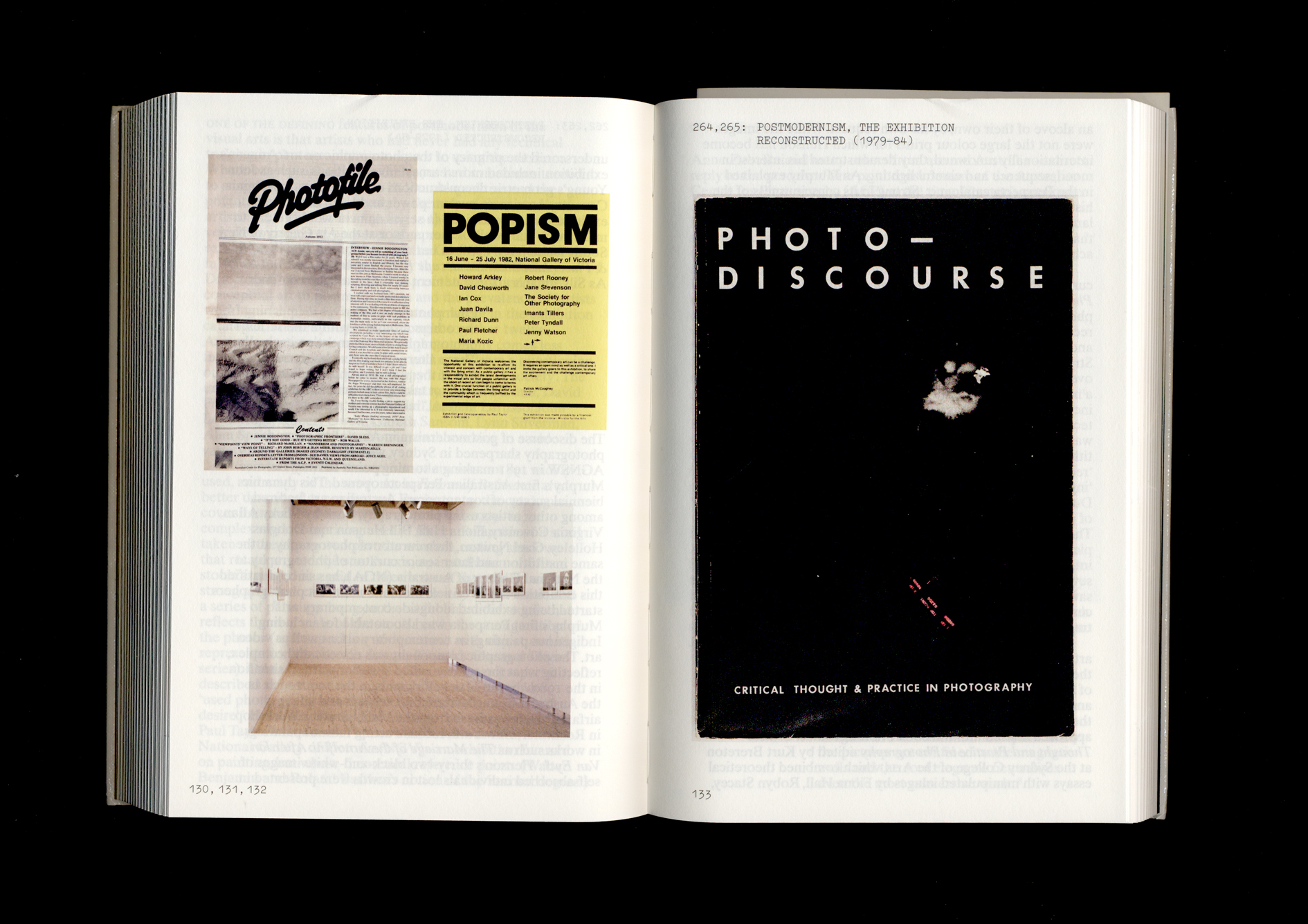
Members of Quadrata had met with the director of the Art Gallery of Western Australia (AGWA), Frank Ellis, in 1980, proposing that photographic art be collected for the permanent collection and that more photography exhibitions be shown at the gallery. While the gallery responded with a series of exhibitions over the following years, each featuring between seven and ten local photographers – including Vizents, Moore, Fiona Girvan-Brown, Edward Edkins, Anne Roots, Stephen Smith, Tom Gibbons – yet Vizents paints a bleak picture of support for photography in WA in a contribution to Photo-Discourse publication in 1981. ‘Neglect is almost total’, he writes, noting that Quadrata gallery would be relocating to his house due to a failed funding application. More positively, he mentions an exhibition on land rights by Mike Gallagher, Moore and Vizents that will tour to ‘outback communities’. Soon after, Darklight Photo Gallery and Workshop in Fremantle operated for a brief period after opening in 1983 (Eugenia Raskopoulos held her first solo exhibition there). Later, a commercial photographer, Chris Ha, who curated a well-received exhibition New West Australian Photography at Carillon City shopping centre in 1991, inspired the creation of the Photography Gallery of Western Australia, which opened in Northbridge in 1992. Co-founded by photographers Les Allester and Paula Shewchuk, the inaugural exhibition featured forty-eight local photographers and, as a flyer proudly declared, ‘by special arrangement, an original print by Ansel Adams’. This ‘important new experiment in gallery space’, as the press release called it, changed hands and relocated several times before morphing into the Perth Centre for Photography, which continues today. Its survival, like so many other photography galleries, has relied on the energy of photographers involved.
In Adelaide, The Developed Image Gallery opened in 1980 and ran for six years, under director Kay Johnston and a philanthropist, Jim Bettison, who provided the funding. The gallery opened with an exhibition of architectural photography by Max Dupain, and held seventy exhibitions, including solo shows by David Moore, Bill Henson and Fiona Hall among others, exchanging numerous exhibitions with the ACP and other interstate photography organisations. Reflecting on its closing in 1986, Johnston argued that the gallery had ‘the aim of first educating an unexposed Adelaide public in the appreciation of photography as a fine art medium’ and had ‘played a key role in creating public awareness of photography as an artform’ in South Australia.7 In Brisbane, Ruby Spowart and her son Doug Spowart opened Imagery Gallery in March 1980. Imagery Gallery held 205 exhibitions of Australian and international photographers before closing in 1995. As a document retrospectively describing the gallery activities details:
From 1980 to 1984 exhibitors were charged commission on sales, however, as many exhibitions have been of a non-commercial or personal content from 1985–95 the gallery functioned on a hire of facility basis. This enabled works which would not be considered viable by commercial galleries to be shown.8
Imagery Gallery also operated workshops conducted by Doug Spowart, who became an agent and second-hand dealer in LEICA cameras and also ran photography tours. By 1988, Imagery Gallery was the only commercial photography gallery in Australia, but these additional activities were crucial to its financial survival.9
By contrast to the precarity of commercial galleries, PhotoAccess was opened in Canberra in 1984 by a group of politically engaged photographers including Huw Davies, who with the assistance of government employment grants opened a community darkroom. With a strong membership culture, and under a series of professionally trained directors sustained by support from ArtsACT, PhotoAccess rapidly evolved, changing its premises from World War II era barrack-like buildings near the Australian National University student residences and food co-op, to properly fitted out spaces in an inner suburban arts precinct. It still thrives as an important and accessible resource with a local, national and international perspective, combining modest gallery spaces with darkrooms, computer laboratories, and national and international residency programs.
Another Photographer’s Gallery also appeared in Brisbane in the late 1980s (c.1988–91), driven by photographers John (MJ) Hawker and Ray Cook. As photographer Carl Warner reflects:
We weren’t part of the QCA crowd or the commercial gallery crowd but had many crossovers … the gallery had a small darkroom and could be used as a studio at night. We gave workshops on film developing, studio portraiture and photo manipulation.10
Some of this energy resurfaced with the establishment of the Queensland Centre for Photography (QCP) in 2004, an artist-run space that operated for ten years, underpinned by generous state government support during an unprecedented mining boom in the state. Initially located at Bulimba and then at South Bank, QCP achieved national prominence with exhibitions and publications by Queensland photographers such as Marian Drew, Ray Cook, Martin Smith and Joachim Froese, as well as five Queensland Festivals of Photography. However, founding director Maurice Ortega and deputy director Camilla Birkeland were forced to close the QCP after a newly conservative state government withdrew core funding in late 2013.
In Sydney, galleries devoted to photography inevitably operated in the shadow of the ACP. A photographer-run gallery called Images Gallery opened in Glebe in 1981 but merged into the Sydney College of the Arts in 1985. Two commercial photography galleries appeared: Byron Mapp, established by a former curator of photography at AGNSW, Sandra Byron, in 1995, and the longer-living and more significant Stills Gallery. Founded by psychologist Kathy Freedman and photographer Sandy Edwards, Stills opened in Paddington in 1991 spurred on by photographers’ ‘general feeling of alienation’ from ACP during its ‘conceptual’ phase – and ran for over twenty-five years before closing in 2017.11 Bronwyn Rennex later replaced Edwards, and as the directors reflected in a press release announcing its closure:
Stills Gallery shifted and evolved to keep up with changes in the way we produce, enjoy and understand photography. These changes included the move to a large converted warehouse space at Gosbell Street in Paddington in 1997, to accommodate the larger works being produced by artists12
During the 1990s, coinciding with the rise of digital prints, the practice of producing numbered limited editions of photographs had become common, as a means to increase the desirability of photography to collectors (although Stills Gallery continued to work with a few photographers who refused to edition on principle). For a moment, during the art boom of the 2000s, a gallery specialising in photography finally seemed viable, with musician and collector Elton John among their best clients. Celebrated contemporary artists were part of Stills’ stable – including Pat Brassington, Anne Ferran, Ricky Maynard, Polixeni Papapetrou, Patrick Pound and William Yang – but the gallery’s reach extended to photojournalists such as Narelle Autio, Stephen Dupont and Trent Parke, and more traditional photographs from the ‘photo boom’ generation such as Steven Lojewski and Roger Scott. Stills was unique in fostering photographic artists throughout their careers, actively participating in local and international art fairs. One of the reasons cited for its closure in 2017 was the rise of art sales online. In a more positive development, a new National centre for Photography emerged in 2018 as part of the Ballarat International Foto Biennale.
-
Isobel Crombie, ‘That “other” centre for photography’, Art Monthly, no. 124, 1999, p. 20. ↩
-
In 1985, the VCP were promised a rent-free space in Abbotsford, together with a financial package for renovation and salaries, only for the space to disappear to a commercial buyer. ↩
-
For Neville, the Australian Centre for Photography was ‘virtually becoming an academy that determines style or ideology… [and] is not so much an Australian centre as a Paddington one’. Greg Neville, ‘Victoria’s photography finds roots’, The Age, Melbourne, 7 September 1990, p. 14. ↩
-
Susan Fereday, ‘Commentary’, in Anne Marsh (ed.), Look: Contemporary Australian Photography Since 1980, Macmillan Art Publishing, Melbourne, 2010, p. 389. This sentiment was echoed in a speech by one of CCP’s founding members, Les Walkling, on its 25th anniversary in 2011: ‘CCP was born out of the agenda of contemporary art, out of an intellectual idea, an understanding that it was needed before there were any bricks and mortar to give it a physical habitable form’. Online at: www.leswalkling.com/words/centre-for-contemporary-photography-25th-anniversary. Accessed 5 August 2019. ↩
-
Beginning in 1990, the VCP/CCP had a close association with the national survey of video and media art organised by Experimenta (formerly known as the Modern Image Makers Association). ↩
-
Tom Molloy, quoted in Alan Vizents, ‘Photography’, Artlook, vol. 6, no. 6, 1980, p. 20. ↩
-
Kay Johnston, ‘The Developed Image: A Personal Statement’, Artlink, vol. 6, no. 1, 1986, pp.14–16. ↩
-
‘About Imagery Gallery: A Snapshot’, online at: https://www.cooperandspowart.com.au/Imagery_Gallery-BIO/Imagery_Gallery-Bio.pdf. Accessed 5 August 2019. ↩
-
Helen Ennis, Australian Photography: The 1980s, An Exhibition from the Australian National Gallery Sponsored by Kodak, Australian National Gallery, Canberra, 1988, p. 15. ↩
-
ARI Remix Project. Online at: https://remix.org.au/memory-and-the-photographers-gallery-carl-warner.
Accessed 25 October 2019. ↩ -
John McDonald, ‘Why the legacy of Sydney’s Stills Gallery will live on after its closure’, Sydney Morning Herald, June 24, 2017. Digital edition. Online at: https://www.smh.com.au/lifestyle/why-the-legacy-of-sydneys-stills-gallery-will-live-on-after-its-closure-20170622-gwwe1g.html. Accessed 25 October 2019. ↩
-
‘About’, Stills Gallery, archived website. Online at: http://www.stillsgallery.com.au. Accessed 25 October 2019. ↩