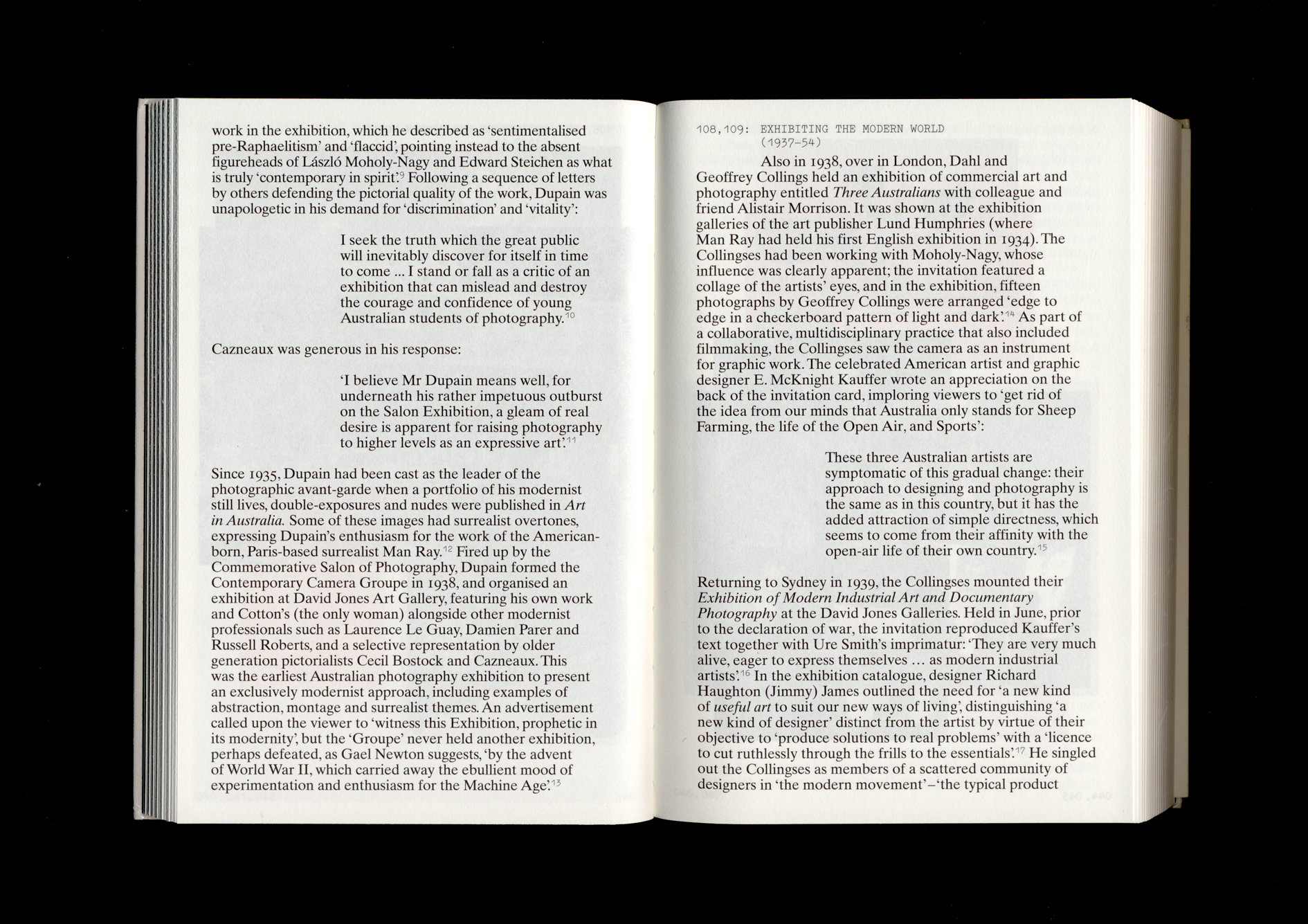
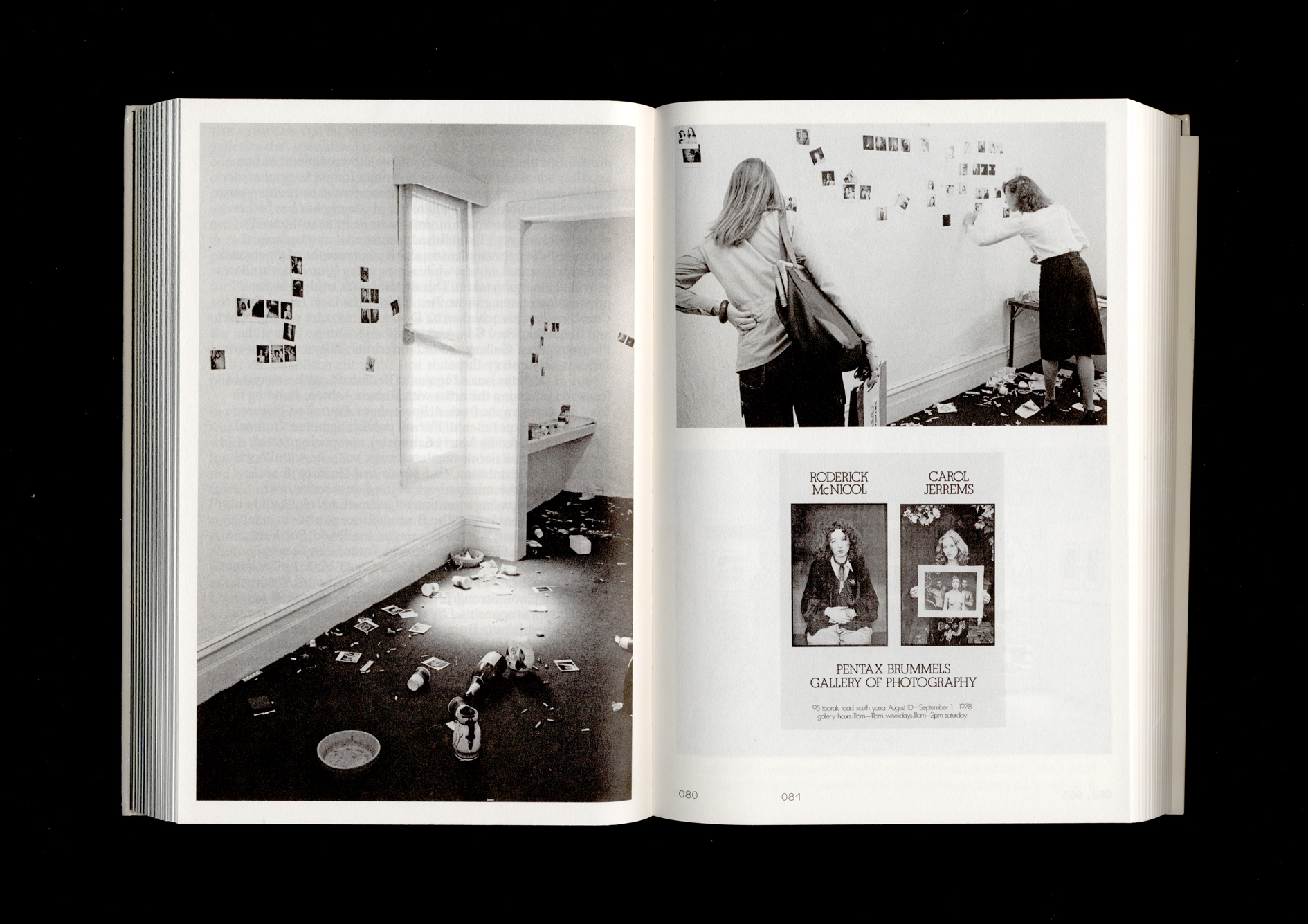
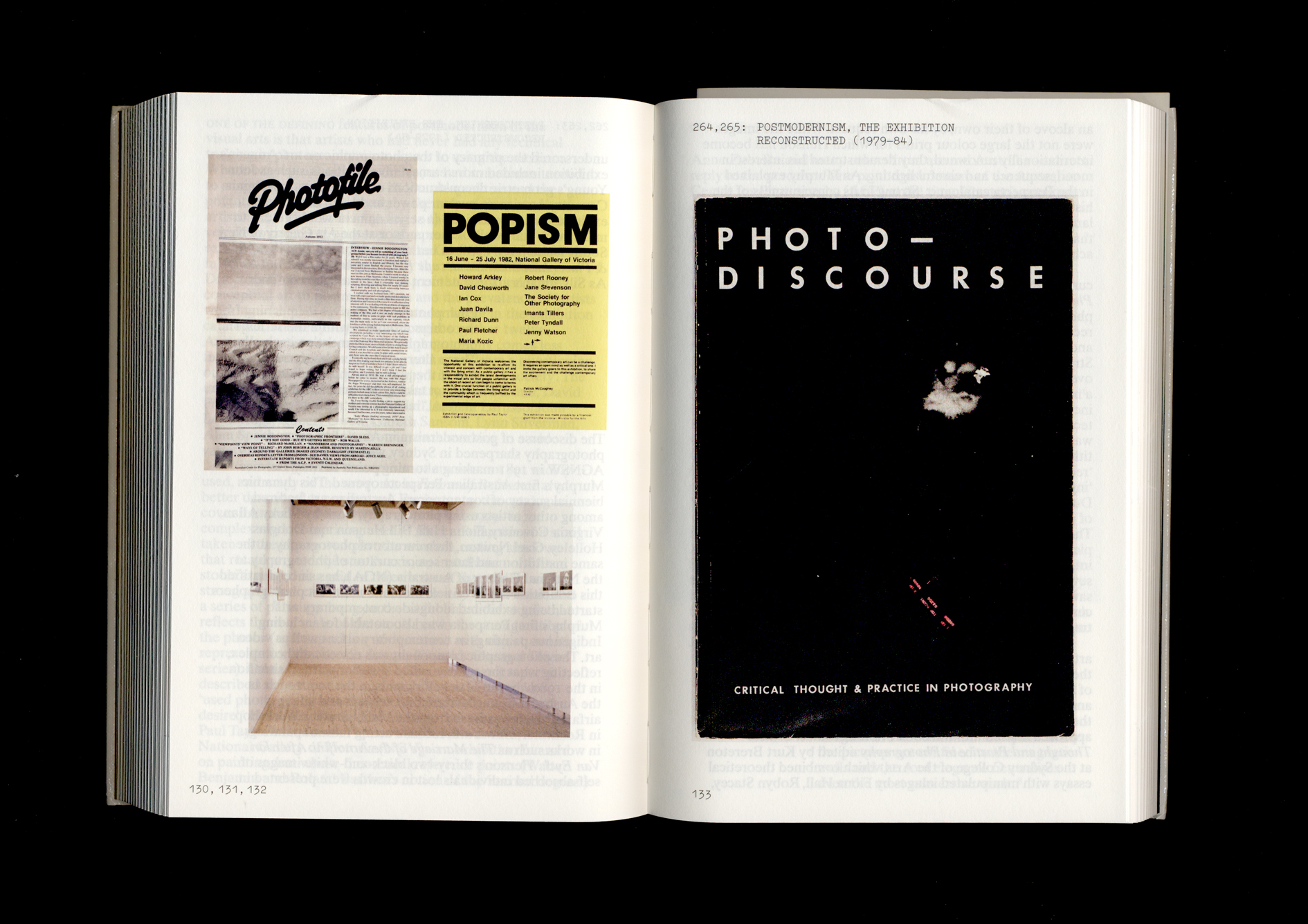
(Installation View, pp. 117–128)
Wolfgang Sievers and Helmut Newton’s New Visions in Photography was held at the Federal Hotel on Collins Street, Melbourne, over five days in late May 1953. Undoubtedly the most significant exhibition of photography held in Australia in the early 1950s, it reflected a new modern approach to the photographic image and its display.
Both Sievers and Newton were émigré artists from Germany who had fled the Nazi regime just prior to World War II. Sievers studied photography at the Contempora School for Applied Arts in Berlin, where he later taught. Newton had trained in Berlin with one of the most established society photographers, Yva (Else Neuländer-Simon), and his success in Melbourne as a fashion photographer in the 1950s laid the foundations for his international career as a subversive high-fashion image maker after he relocated to Paris in 1961. Sievers and Newton had studios on Collins Street and Flinders Lane, respectively, and shared the same printer, Terry Ovenden.1 Both produced sharp images, exploiting radical vantage points and extreme close-ups to produce bold, graphic compositions in high contrast black and white.
New Visions in Photography was Sievers and Newton’s first significant exhibition.2 Both photographers showed advertising and publicity work. Sievers was represented by industrial and architectural studies (notably, the buildings of his friend Frederick Romberg), Newton by fashion, portraiture and theatre photography.3 The work was created in the post-war period that saw a rapid exploitation of Australia’s mineral resources, transforming a hitherto agricultural country into a modern industrial economy. Both photographers, and the companies who employed them, were eager to show that instead of being a continent only of wool, wheat and raw materials, Australia was a sophisticated, industrialised nation. Their approach to photography reflected the principles of European New Photography – that the artist should be directly involved in modern industrial production.
An introductory wall panel, clearly visible in Sievers’ exhibition documentation, declared that the aim of the exhibition was ‘to demonstrate, through actual work done, the potential of industrial and fashion photography as a means of better promotion and bigger sales in business today’. This statement, and the claim that the exhibition was ‘the first of its kind in Australia’, was promulgated in publicity and repeated in newspapers articles.4 The Age newspaper described the exhibition as demonstrating ‘industrial photography’s use in this country’.5 The Argus newspaper ran a picture of the photographers’ wives, who assisted with the arrangement of the display, under the heading ‘Photography to Aid Business’.6 Meanwhile, Sir John Medley, former Vice Chancellor of the University of Melbourne, and the then chair of the National Gallery Trust, who opened the exhibition, reportedly emphasised that the advent of television, bringing advertising into the home, ‘made it important that the standards of public taste should be high’.7
The distinctive staging of the exhibition underscored its attempt to sell an idea of photography’s role in a progressive modernity. While the Federal Hotel was built in 1888 with period pillars, cornices, architraves and chandeliers, Sievers and Newton’s unframed photographs were presented on white pegboard display structures. This unorthodox, magazine-like approach no doubt reflected the fact that Newton and Sievers were not on the exhibition circuit that had originated in the pictorial salons. Their work was normally seen in magazines, trade journals and reports.8 Even more radically, enlarged photographs were suspended in the air with what appears to be fine thread, sometimes on 45-degree angles. One of the suspended photographs by Sievers depicts a factory producing threads, which neatly extends into the real space of the exhibition in a dramatic demonstration of New Photography’s potential for dynamism, and close integration into the logic of modern industrial design and production.
Adding to the modernity of the display, the standing ‘ultra modern’ lamps and the distinctive corded chairs in the exhibition were designed by Melbourne designer and sculptor Clement Meadmore – and are some of the most iconic examples of Australian mid-century design.9 Meanwhile, fellow German émigré Gerard Herbst – art director at Prestige Fabrics, and a friend and frequent collaborator with Sievers – designed the poster for the exhibition.10 Clearly influenced by Bauhaus figures László Moholy-Nagy, Walter Gropius and Josef Albers, Herbst’s poster employs functionalist principles, with two eyes referencing the visual sense of the two photographers presented as geometric forms.
The experience of New Visions in Photography clearly informed Sievers’ solo exhibition in 1955 in Hobart, which also featured photographs on white pegboard, and was opened by the then Premier of Tasmania, Robert Cosgrove. Its influence is also visible in a 1959 view of Sievers’ promotional showcase at Australia Arcade at 9 Collins Street, displaying an array of photographs from his recent geological commissions in remote Australia.
Finally, the modern aesthetic fuses with The Family of Man in exhibitions of photography held at Gallery A, a modern art gallery primarily dedicated to abstract painting and sculpture, which was initially located in a furniture design store on Flinders Lane. An installation view of an exhibition by the Institute of Victorian Photographers, taken by Wolfgang Sievers in 1963 at their South Yarra venue, shows large-scale photographs suspended from the beamed ceiling, as well as suspended white walls cutting across the gallery space – described by one art historian as a ‘dramatic sculpting of the exhibition viewing space’.11
-
Sievers had a well-known falling out with Newton late in his life and is not mentioned at all in Newton’s autobiography: Autobiography, Duckworth, London, 2003. ↩
-
Newton had previously held a solo exhibition of theatre photography at the Rowden White Library at the University of Melbourne in 1950. The student newspaper Farrago quoted Newton as saying, ‘This is my first and probably my last exhibition’. See: Guy Featherstone, ‘Helmut Newton’s Australian Years’, The La Trobe Journal no. 76, State Library of Victoria Foundation, Melbourne, 2005, p. 110. ↩
-
Newton also included a series he was then working on of a Shell oil refinery at Geelong. Featherstone, ‘Helmut Newton’s Australian Years’, p. 105. ↩
-
‘Pictures’, The Age, 21 May 1953, p. 2 ↩
-
ibid., p. 2. ↩
-
‘Photography to Aid Business’, The Argus, 21 May 1953, p. 9. ↩
-
‘TV’s Call on Public Taste’, The Age, 26 May 1953, p. 8. ↩
-
Helen Ennis, ‘Blue Hydrangeas: Four émigré photographers’, in Roger Butler (ed.), The Europeans: Emigré Artists in Australia 1930–1960, National Gallery of Australia, Canberra, 1997, p. 115. ↩
-
An exhibition of Clement Meadmore’s work at the Ian Potter Museum of Art in 2018 featured the lamps and chairs seen in the installation shots. ↩
-
See: Veronica Bremer and Anne-Marie Van de Ven, ‘The Bauhaus Link in the Life and Work of Émigré Artist Gerard Herbst’, eMaj: Online Journal of Art, no. 9, 2016. ↩
-
Andrew McNamara, ‘The Bauhaus in Australia: Interdisciplinary Confluences in Modernist Practices’, in Ann Stephen et al (eds.), Modern Times: The Untold Story of Modernism in Australia, Miegunyah Press, Melbourne, 2008, p. 4. ↩